Here's a link to more pictures from my time in Hyderabad.
Tuesday, December 11, 2012

Saturday, December 8, 2012
Last Day
Sadly, my time in India is quickly coming to an end. This has been an amazing trip. It's been so much more than I ever could have expected, primarily because of the folks on the India BI team who have been such incredible hosts. Sanjay Dutta, Sanjay Agrawal, Vikas Choudhary, Naveen Ramidi, Usha Dugganavandla and Krishna Kumari have made this trip into something I'll never forget.
There are a lot of other photos we've all collected along the way. When I get my hands on them all, I'll post them to Picasa or Photobucket. More to come on this.
Thanks again to everyone in the India office who made this trip a once in a lifetime experience for me.
There are a lot of other photos we've all collected along the way. When I get my hands on them all, I'll post them to Picasa or Photobucket. More to come on this.
Thanks again to everyone in the India office who made this trip a once in a lifetime experience for me.
Hyderabad - The Old City
Today we were fortunate to be able to visit the Old City of Hyderabad. There had been some recent safety concerns in that area and we were all recommended to stay away through 8am this morning. Luckily, that left us one full day to take in what is the central, high volume area of the city.
We started out with a visit to Birla Mandir Temple. This temple is primarily dedicated to Lord Venkateshwara and his two wives; however, it also has shrines for a number of other Gods like Shiva, Ganesh, and Lakshmi. The temple is built entirely out of white marble and is located at the top of a hill. You're not allowed to take a camera inside the temple, so I don't have any of my own shots. Here's one I grabbed from Google Images:

Our second stop of the day was Salar Jung Museum. This is a museum that was created by the last Nizam monarch, Nawab Mir Yousuf Ali Khan Salar Jung III. The Museum name comes directly from the name of the kings of the Nizam dynasty. These guys were a 7 king dynasty that began in 1724 and ended in 1949. Here's a shot from the outside of the museum:

With all the folks that are packed in to the Old City and our lack of time, we simply drove past Charminar. When you see Charminar you're reminded of the big arches you see in European cities like Paris and Rome. Things like the Arc de Triomphe, etc. Charminar wasn't built to celebrate a military victory however; it was built to celebrate the end of a plague.
I would have liked to spend a little time looking at it; however, we had other things to move on to, namely Chowmahalla Palace, the home of the Nizams. To me, this is a pretty amazing palace. Some of our hosts felt like India had a lot more to offer with respect to beautiful palaces. For me, I love walking around places like this that are still significant, but have seen better days. I find it fun to imagine what once was.
We had a lot of fun here, particularly with all the school children who were touring the castle on field trips. If they weren't shaking our hands and asking where we were from, they were trying to get their pictures with us. It was a lot of fun. Here are some of my pictures from Chowmahalla:


 |
| Main building |
 |
| Vikas |
 |
| Beautiful ceiling and pillar of the main building |
 |
| Court area of the main building |


 |
| Ram, Krishna, and Vikas |
Friday, December 7, 2012
Golkonda Fort
One place in Hyderabad I really wanted to visit is Golkonda Fort. Golkonda means shepherd's hill. It is famous for two things:
1. Acting as fortress from the 13th through 17th centuries.
2. Storing important diamonds, like the Hope diamond.
There are a lot of impressive things built into the fort including acoustically designed domes that reflect sound around the fortress as a means of communication, multiple wall systems, water transport systems, gardens, etc.
We visited on Friday evening, just before it got dark. Here's a view from the front gate. Note that this is only the first set of walls. The fortress goes on and up for miles:

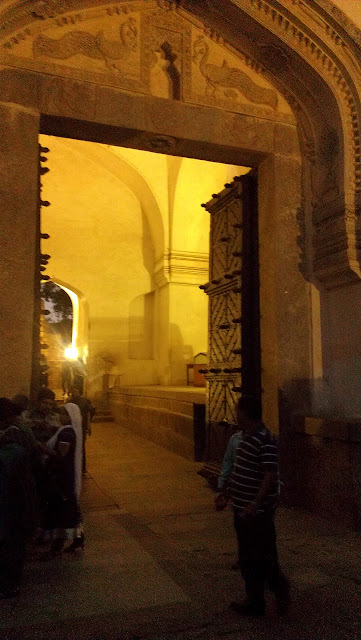
Here's the main gate. Here you're passing through the second set of walls. Note that there's a canon mounted in behind the arch that opens in to the courtyard. The arch in the background is also the location of one of the communication systems designed in to the fortress. The vaulting above that area contains a number of parabolic depressions. If one stands in the middle of the area and makes noise, the sound is reflected around the fortress, providing a mechanism to provide alerts or announcements:
Unfortunately because it was night time, we couldn't walk up the stairs to the top of the fortress; however, we did get to attend the light show, which presents the history of Hyderabad and the fortress. Here's an image from the seating area during the light show. You can see just how large and vertical this fort really is. The show presents the history of the different dynasties that rules Hyderabad, major invasions of the fortress, and security details like the 8km tunnel from Golkonda to Charminar (the old city of Hyderabad):

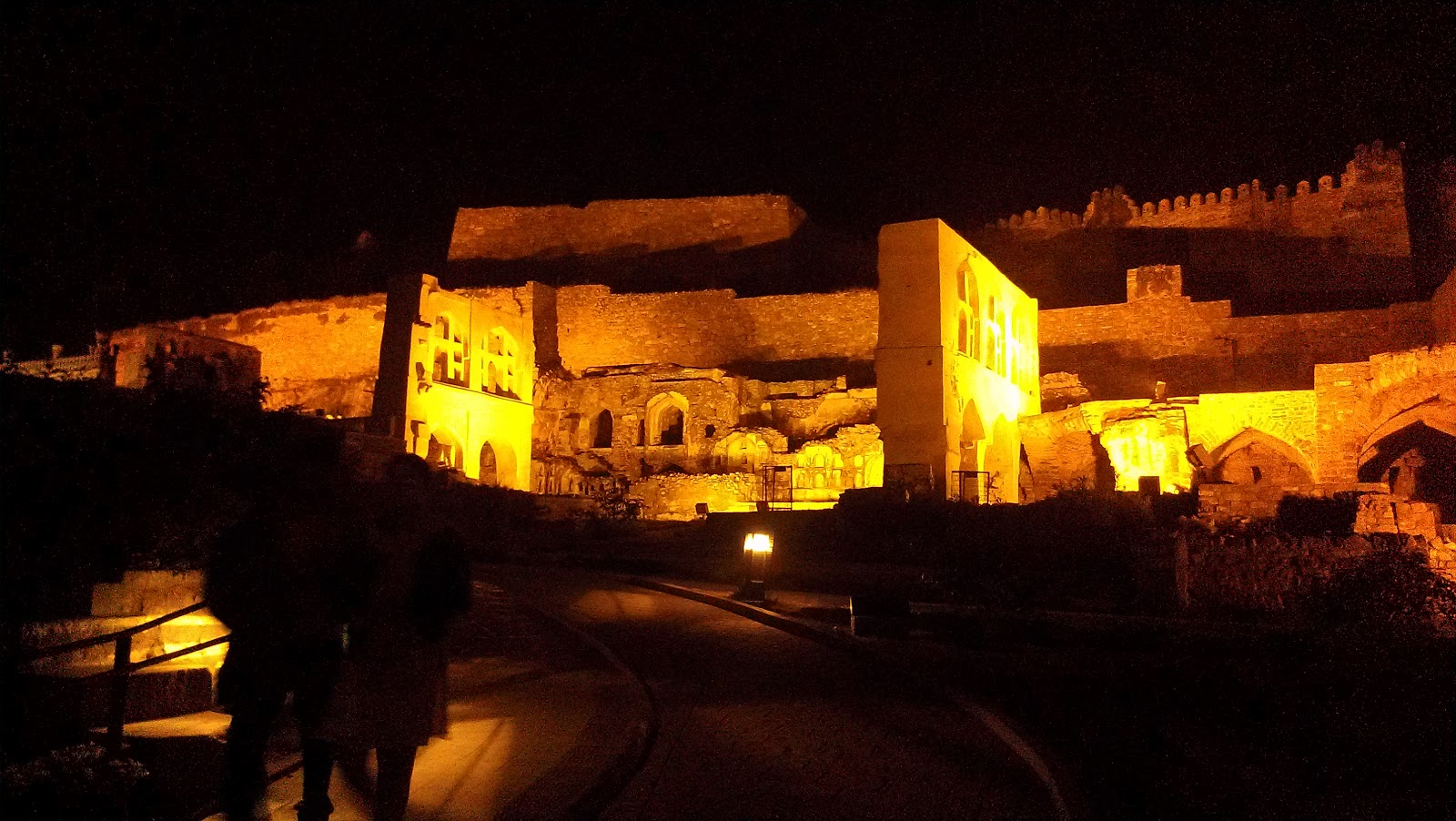
Finally, here's a shot of the fortress on the walk back to the gate:

1. Acting as fortress from the 13th through 17th centuries.
2. Storing important diamonds, like the Hope diamond.
There are a lot of impressive things built into the fort including acoustically designed domes that reflect sound around the fortress as a means of communication, multiple wall systems, water transport systems, gardens, etc.
We visited on Friday evening, just before it got dark. Here's a view from the front gate. Note that this is only the first set of walls. The fortress goes on and up for miles:

Here's the main gate. Here you're passing through the second set of walls. Note that there's a canon mounted in behind the arch that opens in to the courtyard. The arch in the background is also the location of one of the communication systems designed in to the fortress. The vaulting above that area contains a number of parabolic depressions. If one stands in the middle of the area and makes noise, the sound is reflected around the fortress, providing a mechanism to provide alerts or announcements:

Unfortunately because it was night time, we couldn't walk up the stairs to the top of the fortress; however, we did get to attend the light show, which presents the history of Hyderabad and the fortress. Here's an image from the seating area during the light show. You can see just how large and vertical this fort really is. The show presents the history of the different dynasties that rules Hyderabad, major invasions of the fortress, and security details like the 8km tunnel from Golkonda to Charminar (the old city of Hyderabad):

Finally, here's a shot of the fortress on the walk back to the gate:
Thursday, December 6, 2012
Visit to TCS Consulting
TCS Consulting is one of our technology partners in India. Wednesday we headed out to their office to meet with the teams that support our BI Center of Service. Here's a picture of me with the flowers that TCS gave me as a welcoming gift:


Here's us with the TCS team:

(Pujitha, Rhadika, Pradnya, me, Ganesh, Vikas, and Sanjay)
We sat down for a nice meal in the TCS dining room:

Shilparamam on an Auto
The India team was nice enough to take me to Shilparamam this evening. Even more fun is that we all piled in to an auto to get there. 5 of us crammed in. Vikas and Naveen in the front with the driver. Krishna, Usha and I in the back.
Shilparamam is a large park, cultural center, and market that is located near the Hyderabad office. We spent some time checking out the cultural exhibits - things like a modeled Indian village that illustrates how people live in India. Everything from pottery making, to milling grain with stones, to typical daily life. I also had a guy draw a portrait of me, did some shopping, and rode on a traditional bollock (cow driven cart).
Here's some pictures from our afternoon:
Vikas and Naveen in the front seat of the auto:

Usha, me and Krishna in the back:

The Bullock ride:


Krishna driving:
I'll add more pictures later, when I get them from others.
Funny Rickshaw Story
For those who might not be aware, these small motor rickshaws, better known as autos, are everywhere here in Hyderabad. Whether you're seeking transportation for yourself, or your entire family, these guys can make it happen. Here we see an auto (not my photo) carrying a reasonable load of two people and likely doing a good job of it:

Last night we went to a nice dinner on the other side of town. On the way back there was a slow moving vehicle ahead on the road. Traffic was slowing in front of us. If you've been here you know slowing can happen for nearly any reason - a car making a turn, someone parked in the middle of the road, etc. In this case, I look ahead and there's an auto trying to chug up the hill. All of a sudden two guys jump out and start pushing it up the hill. As we passed them, there had to be 6 people literally stacked into the back seat.

Last night we went to a nice dinner on the other side of town. On the way back there was a slow moving vehicle ahead on the road. Traffic was slowing in front of us. If you've been here you know slowing can happen for nearly any reason - a car making a turn, someone parked in the middle of the road, etc. In this case, I look ahead and there's an auto trying to chug up the hill. All of a sudden two guys jump out and start pushing it up the hill. As we passed them, there had to be 6 people literally stacked into the back seat.
Subscribe to:
Posts (Atom)